


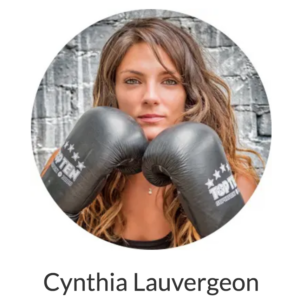
A former elite boxer, Cynthia Lauvergeon was the French runner-up in boxing. Now a sports journalist, she produces documentaries that depict the experiences of female boxers in France and around the world. As part of the Haizebegi Festival, she reflects on her own experience and analyzes the noble art of boxing.
— You danced for six years. Do you think there are any similarities between dance and boxing in terms of how they relate to the body?
Cynthia Lauvergeon: Yes, absolutely. But at first, I had a hard time adjusting to the fact that I had a certain level of coordination thanks to dance. I realized that, yes, it’s similar to dancing—for example, Cuban dance, where they dance in the ring. But the extra dimension with boxing is that you have to take the blows, stick to your strategy, understand your opponent’s strategy, and keep dancing… Our body is a tool.
— You’re talking about the strategic aspect of boxing, calling it a “game of chess.” What do you mean by that?
Cynthia Lauvergeon: I’m going to exploit my opponent’s weaknesses. I’m going to watch her, see how she reacts when I play a certain shot, when I put pressure on her. I liked the counter-punching style—that is, I’d let her throw her punches and then counter by exploiting the weaknesses I’d spotted. Feinting her out. Ultimately, I think it’s the smartest fighter who wins in boxing—not the most violent one.
— You make documentaries. Your latest documentary is about female boxers in Cuba—where women are banned from competing—who train illegally. Despite the machismo, some coaches are willing to train women. Why?
Cynthia Lauvergeon: These are coaches who, for the most part, were boxers on the Cuban national team. They’ve traveled. Cuba is an island that isn’t open to the world. Cubans have been subject to the embargo for decades. They keep to themselves. And when you have the chance to compete at a high level and be on the Cuban national team, it opens you up to the world.
For example, Maikro Romero was an Olympic champion—he’s someone who’s used to traveling. He’s seen women box in international competitions, and he thought to himself, “Why couldn’t Cuban women do the same?”
There’s also the fact that it’s part of Cuban culture. I interviewed Maikro Romero’s wife, a former elite judoka. She says that boxing is in their blood. She says, “Ever since we were little, even us women know how to box—it’s in our blood.”
Women's boxing has been legal in Cuba since December 2022. These coaches fought for its legalization, and they also recognized the potential of women.
— You're about to release your third documentary. What's it about?
Cynthia Lauvergeon: It features these six women. It shows how they balance their athletic careers with their professional and personal lives as well. They each have a different background, and through them we’ll learn a lot not only about them, but also about boxing and elite sports. I’ll also touch on how difficult it is to make ends meet financially. But that’s not the whole story, because they’re doing very well today. We’re fighters in the ring, but we’re fighters outside of it, too. Some of them have gone out and found sponsors and partners. It’s important to me to show what goes on behind the scenes of Olympic qualifying, because people have no idea what’s really involved—so I’ll leave a little suspense…
— What do you hope to convey through this documentary?
Cynthia Lauvergeon: I’d like to raise awareness of elite sports—in the case of female boxers—among the general public. And I’d like the public to root for these girls, too. Sometimes you show up at a competition and see plastic chairs and ten people in the room. You think to yourself, “Actually, nobody cares about what I’m doing.” You don’t do it for that reason, but it’s so hard—it’s such a tough sport. The life of a boxer is one of commitment—or sacrifice; everyone sees it however they want. You give so much of yourself. When you’re competing at the highest level, you have no social life. You can’t go out to eat because you have to stay within your weight class. You have to maintain a certain lifestyle. You live like a monk, and basically, nobody cares. It’s a little frustrating to see that people aren’t necessarily interested in us. I’d like to bring a new perspective on boxing to the general public.
Interview by Yona Bernadas