At the Haizebegi Festival, connection is at the heart of the program, and music engages in a daily dialogue with the humanities. This resonates with the work of Frédéric Deval, who is being honored during the evening of Thursday, October 19. Published today, the posthumous collection of his writings on music, *Petites géométries de l’expérience musical*, is presented by those who accompanied him throughout his life.

When the Humanities Intersect with Music
As a producer and programmer, Frédéric Deval had created a space where artists and artistic languages from diverse backgrounds could come together. He brought a unique perspective to the musical experiments he created. This is evident in his writings, compiled by his wife, Ghislaine Glasson Deshaumes, following his passing in 2016. The Royaumont Foundation, where he headed the Transcultural Music program supporting creative residencies, served as a laboratory for him—a place to observe, question, and reflect. Frédéric Deval had a keen interest in how the humanities could shed light on musical creation. He brought social scientists into his gatherings of artists and was also the driving force behind a partnership with the École des Hautes Études en Sciences Sociales (EHESS). For Frédéric Deval, music was an open window through which one could discover other ways of seeing the world.

Transcultural Programming
Frédéric Deval was highly critical of musical categorizations, particularly those of “world music” and “musiques du monde.” He refused to apply labels or confine an artistic vision to a single word. At the Royaumont Foundation—a Cistercian abbey converted into a center for artistic creation—his “Transcultural Music” program embodied a vision in which the stage becomes an open space where boundaries blur and musical languages intermingle. With diversity as his guiding principle, he brought together varied repertoires ranging from slam poetry to Indian raga, and artists from diverse backgrounds: Arab, Persian, Kurdish, African, flamenco, and Romani musicians… Thus, “imaginary communities” took shape, categories dissolved, repertoires were de-hierarchized, and a new language emerged.
A Humanistic Vision
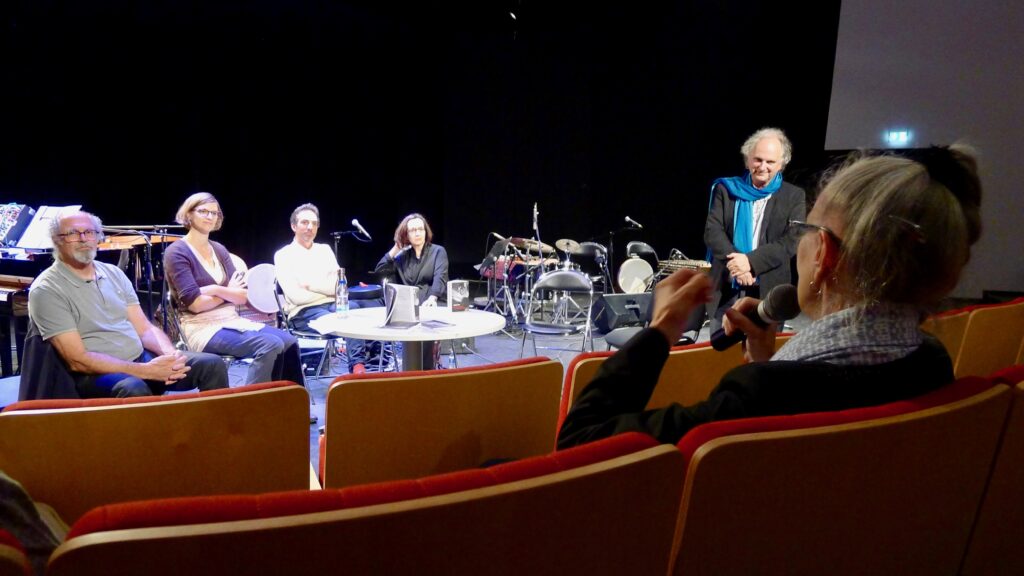
Frédéric Deval’s Transcultural Music program had a political, humanist, and universalist dimension, in which he emphasized that our relationship with others was not a threat but a source of richness. He had a true vision that challenged conventions, broke down barriers, blended languages, and transformed the stage into a space where confrontations could be transcended. During the roundtable discussion, Denis Laborde mentioned the show *Sleep Song*, produced at Royaumont in 2011. It brought together musicians from Iraq and the United States—in direct political resonance with the war in Iraq—with the aim of counterbalancing the violence in the world.
Frédéric Deval rejected any notion of domination or hierarchy, particularly between classical and popular music. He brought diversity to the forefront. This philosophy was embodied, for example, in the show“99,” presented in 2017, a reference to the department code that appears in the social security number of every French national born abroad. In this show, several artists from the 99 region came together on stage, harmoniously blending rap, contemporary jazz, the Indian flute, Iraqi maqams, and electronic bass lines.
Frédéric Deval kept a close eye on the most pressing issues in our society and incorporated them into his projects. Through both poetry and politics, he turned the musical experience into an invitation to step back and perceive humanity in all its diversity and richness.
Mari le Diraison