


Albaola completes his replica of the whaling ship San Juan (1563–1565)

Albaola Faktoria Maritime Basque is hosting the final day of the Haizebegi festival. There, visitors can see the hull of the San Juan, which is now nearly complete. It is awaiting its rigging so it can set sail, just like its 16th-century predecessor. The whaling ship San Juan, which sank in 1565 off the coast of Red Bay, Canada, was rediscovered in 1978 by underwater archaeologists.
The cold water temperature and the silt covering the wreck preserved most of its components, much to the surprise of the archaeologists, who meticulously excavated it over a period of six years. In 2013, the Red Bay archaeological site was designated a UNESCO World Heritage Site. Albaola then took over the research, entrusting its shipwrights with the task of building a replica of the San Juan—originally built in Passaia in 1563—using period tools.


Located in Pasaia San Pedro in the Spanish Basque Country, Albaola is an innovative center whose main activity is the construction of historic vessels, where traditional maritime craftsmanship is revived and showcased. As such, this shipyard/museum/international school of marine carpentry/naval model-building workshop/resource center open to the public is one of the four partners in the project to create the Basque cultural center, “Baskasetur, ” in Djupavik.
Basque Heritage Honored by an Icelandic Storyteller
The port of San Pedro in Passaia has seen countless young Basque men set sail on whaling ships for endless hunting expeditions in the cold waters of Newfoundland, Greenland, and Iceland. How many of them never returned? Some, perhaps, were massacred in the fjords of northwestern Iceland. In their memory, Elfar Logi Hannesson offers a particularly vivid reading of the “True Account” of the Basque massacre. He and his wife needed to see and feel the sea on this Basque coast before returning to the small 60-seat theater they both manage in Iceland’s Westfjords.

Txalaparta, the smart instrument project
The txalaparta is a Basque percussion instrument consisting of wooden planks—called taulak or oholak—that are usually placed horizontally on trestles. These planks are struck vertically by two pairs of short sticks—called makilak—played by two musicians, respectively, who interact without ever striking a beat at the same time as the other.
Learn more about the txalaparta
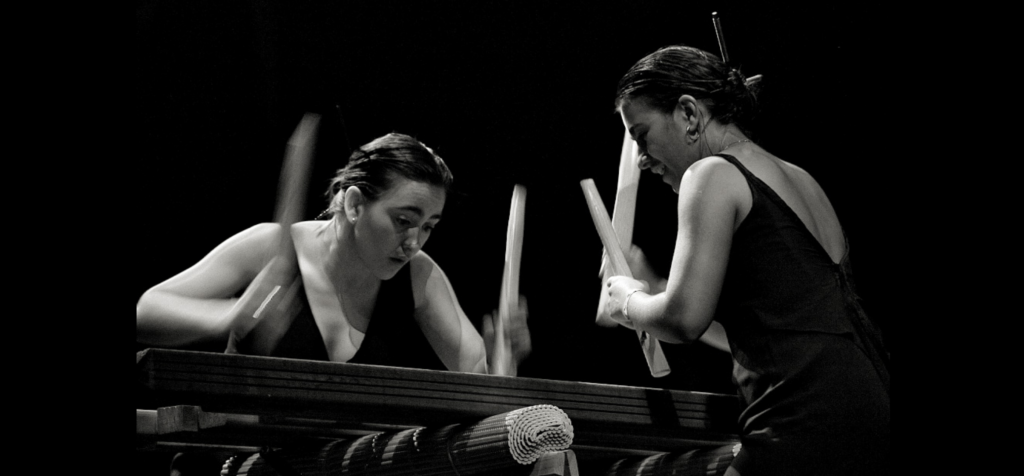
Thor Magnusson, principal investigator at the Intelligent Instruments Lab in Iceland, has set his sights on the txalaparta as a tool for experimenting with artificial intelligence (AI). Indeed, the txalaparta has the advantage of being played by two people, allowing the AI to serve as the second player interacting with a human player.
A collaborative project has been launched with two musicians from the Basque Country, Ibon RG and Enrike Hurtado, who regularly visit Iceland. Workshops have been organized to teach young Icelanders how to play the txalaparta. And Thor Magnusson has devised a fictional scenario developed with the help of ChatGPT.
This scenario imagines that Basque whalers, who had come to hunt off the coast of Iceland, might have crafted txalapartas from these pieces of driftwood—originating from Siberia—that had piled up by the thousands at the bottom of Iceland’s fjords, and that they might have played them for their own enjoyment.
He imagines a Basque sailor tapping on one end of a wooden barrel while another sailor listens at the other end. If the latter hears no clear sound, it means the barrel is full of water and therefore unusable. But if it resonates like a txalaparta board, then it’s worth considering. There would thus be a plausible connection between the Basques who processed whale oil on Icelandic beaches and the practice of striking wooden logs on those same beaches, then playing them like a txalaparta.

Thanks to ChatGPT, which knows how to craft sentences, an entire story has been spun about these txalapartas made from driftwood and how Basque whalers played them on the beaches of Iceland. Victor Shepardson, who works with Thor Magnusson, explains: “Of course, it’s completely fantastical, because no one has ever reported such practices. But we actually tried it out by going to a beach, surrounded by fishing debris, to play the txalaparta with driftwood from Siberia. We had a lot of fun!”

The txalaparta & AI experiment presented at the closing of the Haizebegi#11 festival still leaves room for further research in this field. Fed with txalaparta recordings, analyses, readings, and sounds from musicians playing the instrument, the AI should be able to respond in the same way a second player would interact with the first while playing. At least, that is the goal set by researchers at Thor Magnusson’s lab.
The txalaparta/AI duo performance we saw in Passaia showed that the research is still far from complete. But let’s stay tuned, because it may well succeed one day. What will become of txalaparta playing then?…