


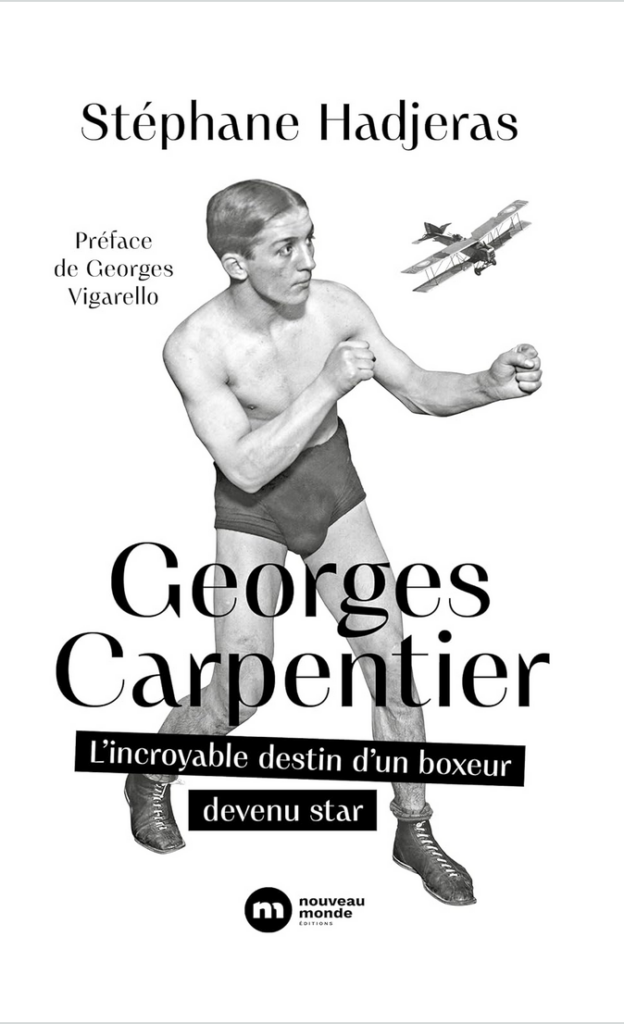
Stéphane Hadjeras, a historian and boxer, discusses sports archives, changes in the world of boxing, and his recent book, *Georges Carpentier: The Incredible Story of a Boxer Who Became a Star*.
— What motivated you to undertake this dissertation project on Carpentier?
Stéphane Hadjeras: I think, like any research project, it has to be driven by passion. I’ve had a passion for boxing since I was a teenager. I did a little boxing myself, and ever since then I’ve always been interested in the history of boxing—especially through the boxers’ autobiographies I read and the accounts written by journalists.

In 2010, I felt the urge to return to research while I was working as a high school teacher. The idea had already been on my mind, partly because I had also taken up boxing again around that time. I had taken my son to boxing class and had resumed training so I could keep up with him. I also started getting involved with the boxing gym’s board. I first took on the role of secretary, then became the club president. I wanted to do historical research on boxing. And in fact, it was my future research advisor who suggested and steered me toward Georges Carpentier. He specializes in the history of soccer. In his research, he came across Georges Carpentier quite often. Carpentier was omnipresent in the press during the Belle Époque—a figure who was extremely prominent.
As a boxing fan, I was, of course, familiar with Georges Carpentier. He was France’s first-ever world champion, and he fought a legendary bout in 1921 that left a lasting impression on the public’s imagination—the World Heavyweight Championship. He served as a pilot during World War I. He’s truly an interesting figure, a figure from the annals of history. He emerged at the dawn of sports entertainment. And during my initial research on Georges Carpentier, I realized there was a real thesis topic there, and I became passionate about this work.
— What changed in boxing when Carpentier arrived, at the same time that the “star system” was taking off?
Stéphane Hadjeras: Carpentier is interesting because he represents the dawn of what I call “visibility.” Celebrity already existed; historian Antoine Lilti has studied the invention of celebrity since the 18th century, focusing on figures like Rousseau and Voltaire. But with Carpentier at the start of the 20th century, it’s all about visibility. In other words, you can be famous without being recognized on the street. With Carpentier, you’ll be famous and recognized on the street. That changes quite a few things, particularly the phenomenon of fans.
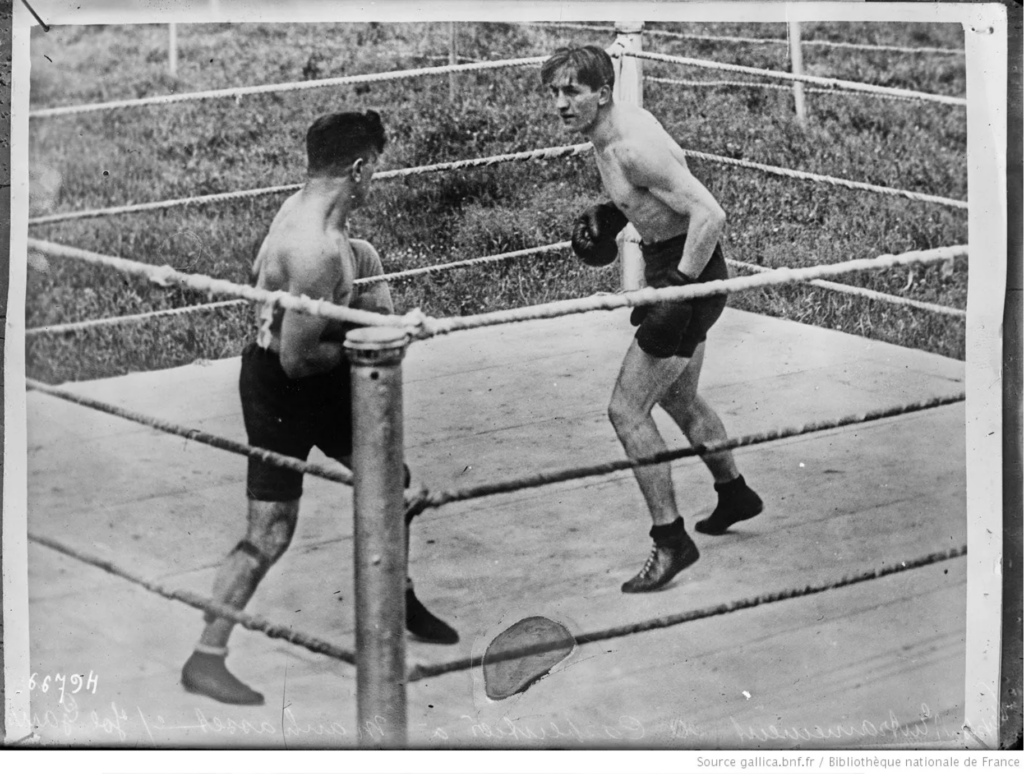
What struck me during my initial research were precisely the front pages of newspapers from the Belle Époque. The offset printing process—which allows for the mass reproduction of photographs—had not yet been invented. There are photos in a few newspapers, but not that many. And there are front pages from major newspapers of the time featuring nothing but Carpentier’s photograph. I’d been working on *Le Petit Comtois*, a newspaper from Franche-Comté, and *L’Ouest Eclair*—which can be found on Gallica—covering a famous Carpentier fight on June 1, 1913, when he became the European heavyweight champion. In fact, the very next day, on the front pages of the newspapers, there was nothing but his photo. There was nothing else. There was text—lots of text—but nothing else. The front page was just the photo of Georges Carpentier. And in the major Parisian newspapers, it was the same thing. So, it’s only natural that he’s recognized. He was only 19 years old.
— What does your job at the French Boxing Federation (FFB) entail?
Stéphane Hadjeras: The FFB is a very recent development. We’ve set up a History Committee with the president, Dominique Nato, who has a keen interest in the history of boxing. The idea is to highlight the FFB’s heritage and archives. It’s a federation that’s been around since 1903, and it has a rich historical legacy. But, like all sports federations—and this isn’t unique to boxing—in sports, we tend to focus on the present or the future. The goal is what’s concrete, immediate, and results-oriented. The heritage and history of the sport aren’t considered that important. They’re sometimes relegated to the basements. When I started my doctoral dissertation, I went to see the FFB, and they told me outright that there was nothing—no archives—and that everything had been burned. Fortunately, the new president, with whom I hit it off, was more attuned to history, and from there we began considering the creation of a History Committee to highlight this heritage. Because boxing has a rich history.
Interview conducted and transcribed by Jérémy Casaux