


At the opening of the Haizebegi Festival, the focus was on current events in Ukraine. Hamit Bozarslan’s lecture on the struggle for democracy unfolding in Ukraine served as the prelude to a concert of polyphonic songs by the Kurbasy duo.
“The Ukrainian people fight while singing.” For the festival’s opening, Ukraine reveals itself at the crossroads between ancestral songs and reflections on the current situation of a country at war. Hamit Bozarslan’s lecture and the concert by the Kurbasy duo echo this theme. They bring to light the struggle of a “people who fight with song on their lips.”

Double-blind study
Hamit Bozarslan, who came to present his latest book, *Ukraine: The Double Blindness*, examined the foundations of contemporary Russian political thought as well as the failures of Western democracies. The historian and political scientist describes both the “gothic, undead” mechanisms of power in Putin’s Russia and the blindness of the Western powers, blinded by the illusion of a “completed democratic mission” since the dismantling of the USSR.
Hamit Bozarslan’s work has the merit of reframing the Ukrainian issue around the concepts of democracy and anti-democracy, moving away from the outdated North-South or East-West frameworks. The Ukrainian resolve, embodied by Volodymyr Zelensky, takes on a new dimension: a struggle not only for independence, but for the preservation of a fledgling democracy.

Songs of the Ukrainian Forest
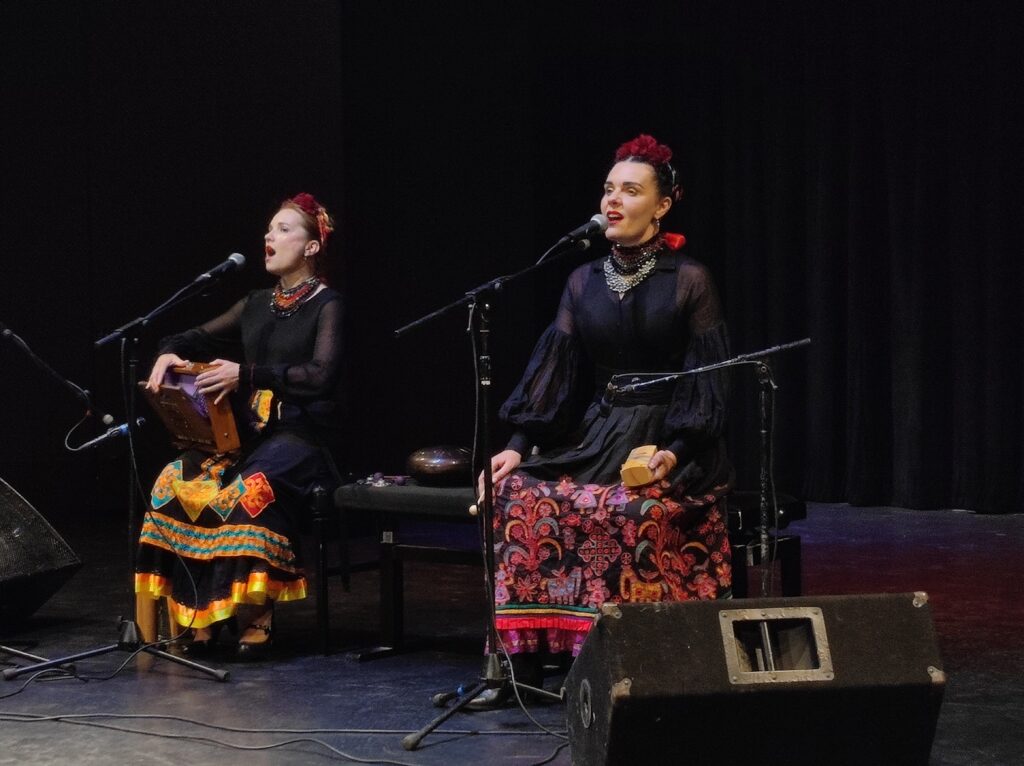
Founded in 2008 by Mariia Oneshchak and Nataliia Rybka-Parkhomenko, the duo Kurbasy takes its name from the postmodern and avant-garde theater troupe Les Kurbas, based in Lviv, Ukraine, from which they hail. As actresses and singers, their performances skillfully blend a variety of instruments, polyphonic harmonies, and some Indian-inspired sounds, accompanied by the shruti box.
Composed in 2020, the show presented on Thursday evening was born out of the COVID-19 health restrictions. Confined together in Mariia’s house, on the edge of a forest, circumstances led the two artists to compose a work inspired by traditional songs from various regions of Ukraine and the world of the forest. Through interplay of silence, polyphony, and enchanting tinkling sounds, Mariia and Nataliia invite the audience to immerse themselves in Ukrainian folklore.
Time for discussion
The two artists present a multifaceted body of work that straddles the line between lullabies and heroic—even dramatic—tones. Melancholy and tenderness blend with the chirping of birds and a poetic imagination that veers toward the epic.
Set against a Babel-like jumble of overlapping spoken words, the performance invites the audience to engage in discussion from the very beginning. Through the various songs, the voices harmonize—and at times clash—amid agreement and disagreement, embodying the full diversity of a silenced people.
Transmission
Ultimately, the piece offers a moment of meditation. Its strength lies in its capacity for reflection. It transports the listener and provokes thought. The musical exploration that unfolds within it plays with different temporalities. Straddling ancestral heritage and pressing current events, it serves as a vehicle for a dual transmission: a transmission from older generations of Ukrainians to the younger ones, as well as from two artist-ambassadors to their Basque and French audiences. The duo thus skillfully represents the rich diversity of Ukrainian culture while amplifying the voice of a people in struggle, from abroad.
Jérémy Casaux