


Two Ukrainian singers committed to preserving traditional Ukrainian culture
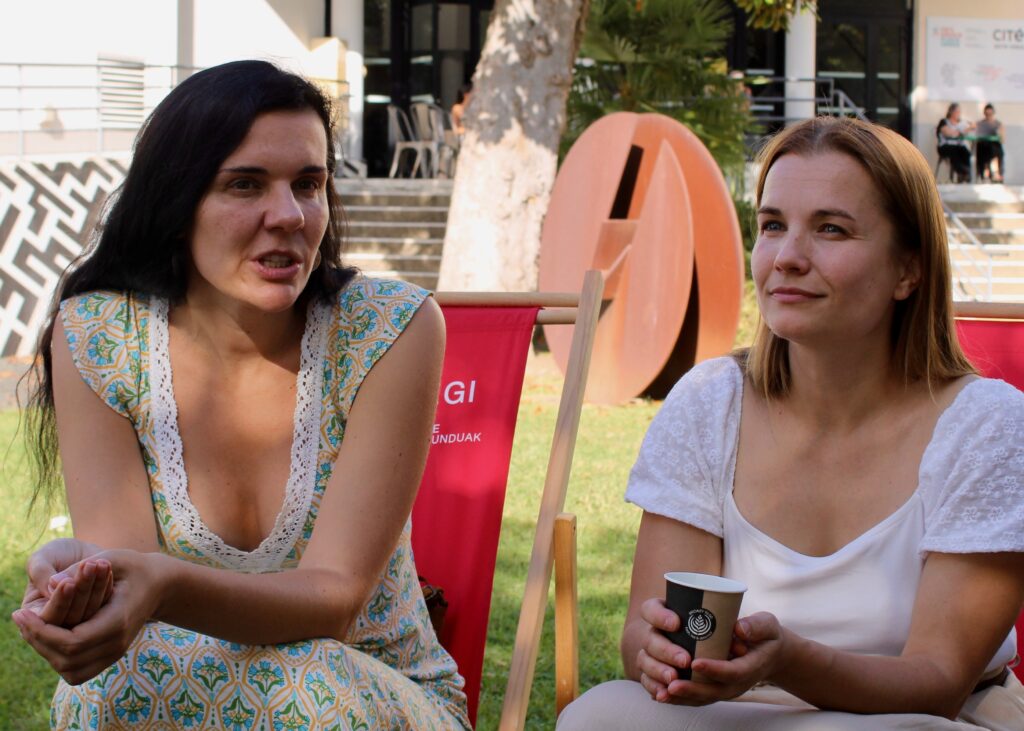
As agreed, we meet the Kurbasy Duo backstage at the Cité des Arts Auditorium after their dress rehearsal. Mariia Oneshchak is ironing her skirt for tonight’s concert. Nataliia Rybka-Parkhomenko asks us if we can do the interview outside. Tonight, they will present a show featuring traditional Ukrainian songs titled “Polyphonic Songs of the Ukrainian Forest.” We spoke with them on the lounge chairs at the Haizebegi Festival, in the gardens of the Cité des Arts in Bayonne. This interview would not have been possible without the help of Louise Henry, our translator, whom we would like to thank once again.
– We noticed that the show consisted entirely of Ukrainian folk songs. Could you explain what makes these songs so distinctive?
Mariia Oneshchak (M.O.): In Ukraine, we’re truly fortunate to have such a vast repertoire of folk songs. Many of these songs have been passed down through the ages. They were collected, in particular, by Ukrainian poets, and that’s why we’re here today—to carry on this tradition and sing these songs.
Nataliia Rybka-Parkhomenko (N.R.-P.): Actually, singing is our strength. It’s truly a very powerful tool for telling the world our story—and for reminding ourselves of it, too. It helps us remember just how strong we are, and just how free we are as a people.
M.O.: Song also shows just how ancient the Ukrainian people are—we’ve been around for a very long time. Today we’re in a war, a fierce struggle against Russia, and this war didn’t begin two years ago or in 2014. It began hundreds of years ago—perhaps even millennia ago.
N.R.-P.: The good thing about Ukraine is that, to learn about this national treasure, we can read books, but above all, there are still elderly people—grandmothers—in the villages who can pass this treasure on to us. We can visit the villages and go to their homes. We can have coffee with them or something else, and they sing these songs for us and pass them on to us.
– How was the repertoire of works to be performed tonight put together? You selected 14 songs from different regions. How did this creative process unfold?
N.R.-P.: Mariia and I have known each other for 20 years. We’ve been singing these songs throughout our friendship. In 2020, there was COVID, and then we found ourselves together at Mariia’s house. She lives not far from a forest. We sang in the forest. That’s why tonight’s program is called “Polyphonic Songs of the Ukrainian Forest.” For us, it represents all those years of friendship. It also happens that we come from different regions of Ukraine.

– You come from a theater background, and you mention poetry—what influences and sources of inspiration led you to create this show? Poetry, theater, politics…?
M.O.: Our work is influenced by poetry, and by theater as well. At the Kurbas Theater—where we got our start in Lviv—the director often blended poetry and song. All the actors who perform at that theater sing. Singing is also poetry—but sung. Ukrainian poets such as Bohdan Ihor Antonych, Lesya Ukrainka, and Ivan Franko are among those who have inspired us. As poets, they, too, engaged with this musical and traditional heritage.
N.R.-P.: I’d like to add that theater gives us the freedom to improvise. Every performance we put on has its own soul, so to speak; there’s a concept behind each one. For example, the show we’re performing tonight is a bit like a Ukrainian meditation, and we choose the instruments that go with it. So yes, theater does give us that freedom to perform.
– And is there a reason why tonight’s show consists solely of music, without any theatrical elements?
N.R.-P.: The project we’re presenting to you tonight is the group Kurbasy. It’s an independent project. So it’s obviously connected, because the theater is called Les Kurbas—that’s where the name comes from. But in fact, it’s a separate project. We’re still working in theater; we’re still actresses—nothing has changed in that regard—but we have these two distinct projects, which are ultimately intertwined.

– Given the current war in Ukraine, what does it mean to perform Ukrainian folk songs here in the Basque Country?
N.R.-P.: It’s very important to us to share this music not only with the Basques, and not only with the French, but with as many people as possible. Since 2022, the world’s attention has been waning every year. We really want to remind people of what’s happening here. First and foremost, we want to show who the Ukrainians are; we want to evoke an emotional response. Next, we also want to make it clear who our enemy is. It’s Russia; it’s Putin. He is the embodiment of absolute evil. For us, song is a very powerful tool for conveying political ideas—an act of diplomacy. It’s a slightly “softer” channel. And perhaps the last thing we want is also the chance to make the French fall in love with Ukrainian music, to touch people’s hearts. Yes, maybe some French people here tonight will fall in love with Ukrainian songs.
M.O.: Our mission is also to remind people that we exist, because Russia is doing everything it can to make people believe that Ukraine doesn’t exist, that Ukrainian territories are Russian territories. When the war started, I was in the United States with my children. We were on tour. That’s when someone said to me, “Oh, so there’s actually a difference between Ukrainians and Russians? I didn’t know they were a separate people.” And for us, it’s very important to remind people that yes, we are a separate people with territories that belong to us.
N.R.-P.: We really wish we could bring you better news today; we’d love to tell you about a “happy ending,” but unfortunately, that’s not at all what we’ve come to tell you. Things aren’t getting better in Ukraine, and we can see that the situation is getting worse on a global scale.
Right now, a lot of attention is focused on Israel, while in Ukraine, in the eastern part of the country, there are regions where the fighting has intensified. So much so that our soldiers said this week that, in the two years of all-out war, there had not been fighting of such intensity in certain regions of the east.
For now, the fight continues, and we’d love to talk about more positive things, but we can’t. This isn’t pessimism. We’re simply being realistic. We’re convinced that if he could, he wouldn’t just “devour” Ukraine. He’d devour the Basque Country, too. To you, that might seem far away. It’s somewhere out there. But in fact, it’s very real. And it’s only when you experience it firsthand, when you’re right there, that you can truly grasp the full extent of what’s happening.
I’d also like to add that the men and women fighting on the front lines are showing Cossack-like courage. But in reality, it’s not just about courage. Without Western weapons, I don’t know where Ukraine would be right now, and we’re holding on thanks to them. It’s very important that this aid continues.
Interview by Yona Bernadas and Jérémy Casaux