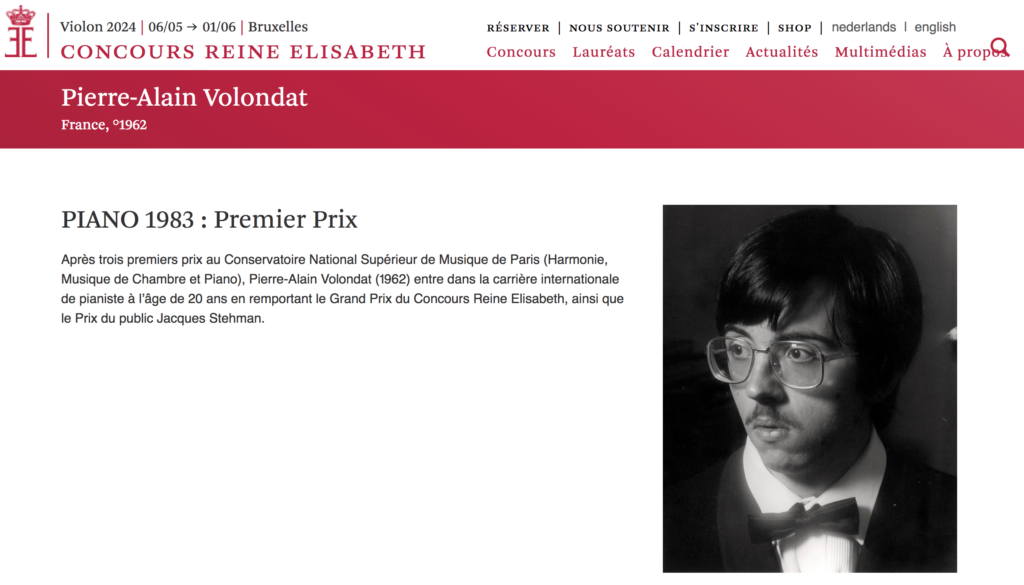
Queen Elizabeth Music Competition Grand Prix, 1983: Pierre-Alain Volondat, barely 20 years old, was thrust into the spotlight. For the first time in the competition’s history, a winner took home all the awards. After his performance at the tenth edition of the Haizebegi Festival, he opened up.

— What does the piano mean to you?
Pierre-Alain Volondat: Oh, it’s been a long time. The first time I heard it, it was the sound that really appealed to me. It’s both crystal-clear and sensual… In short: I just liked the sound of the piano, that’s all.
— How did you get started playing the instrument?
Pierre-Alain Volondat: I started playing the piano at age 7, so I can’t really be considered a child prodigy. I came from a modest family; my parents weren’t musicians. I wasn’t pushed, and no one discovered my talent. However, my mother fought tooth and nail to help me become who I am today. So I entered the Paris Conservatory at age 17, graduated at 19, and competed in the Queen Elizabeth Competition at age 20. But my journey has been very difficult. It hasn’t been a smooth ride for me.
— In a documentary about you, you say , “Everything becomes music”…That a good teacher is, above all, a great master. For you, was Vera Moore the one who filled that role?…
Pierre-Alain Volondat: Absolutely, yes, and I still believe that. It was Vera Moore who prepared me for the Queen Elizabeth Competition. She had me study the traditions of Clara Schumann and Beethoven, which she has inherited through several generations. She also taught me the sculptural dimension of the piano. An interpretation is precise down to the last note, down to the last nuance—it’s an incredibly difficult task. There are some who want to be called “master, ” who sometimes ask , “Do you know who I am?” I always reply slyly , “No.” Mastery isn’t a title or a rank—it’s a state of being. It’s a path marked by anxiety and stage fright, and above all, it’s about self-control. You can be a master one day and no longer be one the next.
— Did you also take on that role as a teacher?
Pierre-Alain Volondat: Later on, yes, that did happen to me. In fact, I’m one of Alexandre Kantorow’s teachers. Among other things, I helped him prepare for Liszt’s Second Concerto. I remember a three-hour lesson where we still hadn’t finished going through the concerto, because I had so much to say, and I just wouldn’t let it go. It’s true that when I hear him play it, there are moments where I want to say , “Hey, that’s mine!” But that’s okay—it’s normal—and he’s the next generation.
— Tonight, you performed Franz Liszt’s Sonata in B minor. How did you choose your repertoire for Haizebegi?
Pierre-Alain Volondat: Denis Laborde suggested Liszt’s sonata to me. It had been about twenty years since I’d last played it, so I took it up again. The biggest challenge when you play a piece you already know well is to start with a clean slate and work on it as if you were hearing it for the first time. If I haven’t had the career I could have had, it’s also because I never wanted to be tied down by preconceived notions of interpretation. Today, I’m completely free, and I think the important thing is to go as far as possible, to follow your ideas to their fullest extent.
— What makes for a good performance?
Pierre-Alain Volondat: It’s obviously subjective, and art—unlike science—isn’t judged by proofs and theorems. But the interpretation that works is the one that sweeps the audience away. Interpretations can vary greatly, but either a connection is made—or it isn’t. If it doesn’t connect, it means there are things that aren’t right. Or that don’t suit the musician personally—in fact, there are works I don’t play because they just don’t connect. But I think all artists can have good interpretations, and very different ones at that. Sometimes I hear pieces and think to myself , “Well, why not?” In any case, interpretations evolve, just like the aesthetic language of writers. When you listen to artists from the past, you realize that people don’t write like that anymore, and they don’t play like that anymore. It’s all changing.
— In the 1980s, you said you knew you had a mission to fulfill, and that you could not die until you had completed the work that had been entrusted to you… Do you think you’ve achieved that goal?
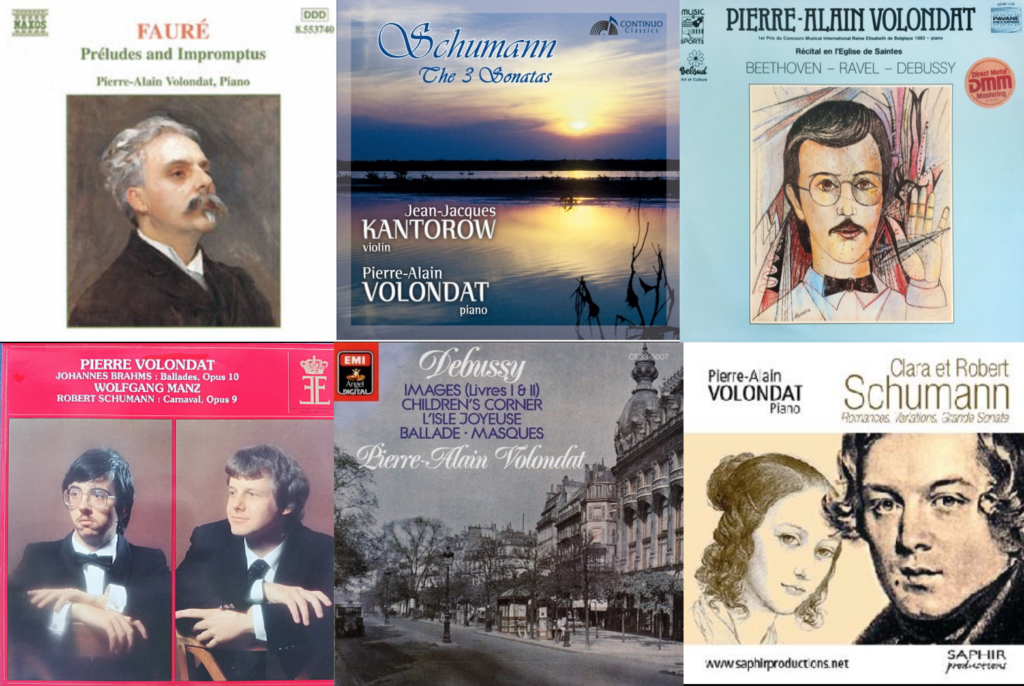
Pierre-Alain Volondat: That’s true, but I feel a little guilty for having been presumptuous in that regard. What that mission was, I have no idea. But I believe that, up until now, it’s been a mission of sharing. That’s what a lot of artists forget, because of the fans and the media pressure. The essence of music is the spirit of sharing. I’ve done a bit of recording, but I prefer performing live. I think you have to know how to play like a champ—like someone who isn’t afraid of anything. It’s about being authentic, right there in the moment. In the studio, you redo things; you take it again. It’s different.
Interview by Margot Artur de Lizarraga
The recording of the Queen Elisabeth Competition, which won unanimous acclaim