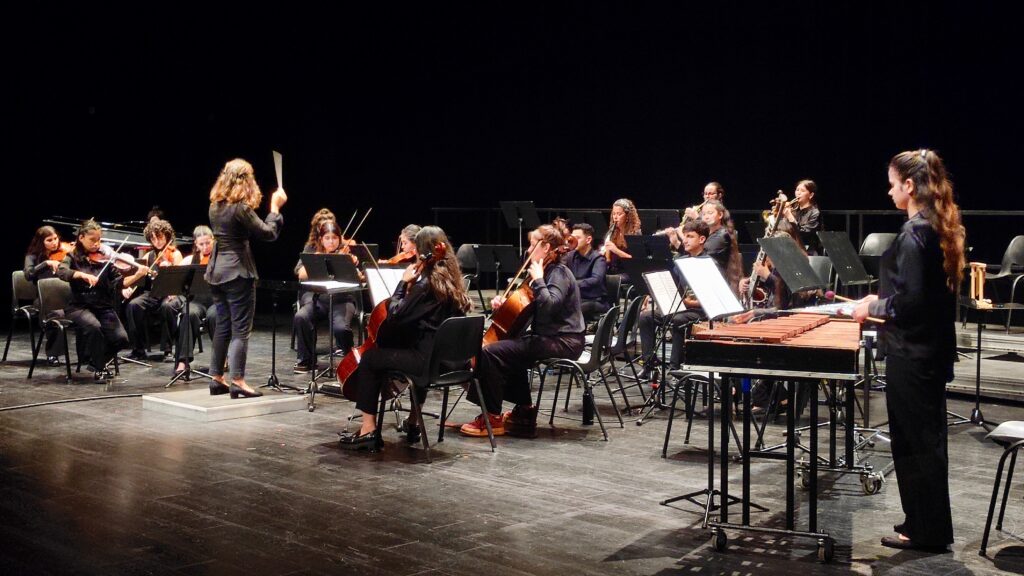
For its first concert since going into exile, the all-female Zohra Orchestra performs a repertoire that blends Afghan traditions with Western influences. The young Afghan trumpeter named Zohra, who joined the group with her cousin, opens up.

— What was the process for selecting the songs that will be performed tonight?
Zohra: Of the songs we’ll be playing, the [Zohra] orchestra will perform 8. There’s also a small ensemble that will play a few other songs. In total, there will be 14. Something like that. So we’ll be playing eight Afghan pieces and one Disney piece—the one from Rapunzel.
— Why did you choose that
Z.: When it came time to choose the songs, the teachers suggested we pick any song we wanted—as long as it was fun. So we chose “The Dance in the Kingdom” from *Tangled*. It was a suggestion from one of the students, and everyone agreed.
— And were the other pieces chosen by your teachers?
Z.: It was also the students’ choice. The teachers just asked us which pieces we wanted to play. And the students voted on the pieces—the ones we’ll be playing. The students got to choose all the pieces. At first we’d decided to play nine pieces, but we didn’t have time for all of them. There are two different orchestras. They’re made up of the same people, but one consists of those who have been playing for a long time—several years. The other group includes students who have only been learning for a relatively short time, so their proficiency isn’t quite there yet. That’s also why we didn’t have time to play all nine pieces originally planned for the full orchestra. We decided instead to have a small group perform a few of them as the opening act.
— There are some differences in skill level among you all. What are the reasons for this,
within the full orchestra?
Z.: Because we’re young students, we need a lot of practice. My fellow trumpet player, for example—there are two of us—is French. She wanted to play with us, but she started playing the trumpet several years ago. We’re not at the same skill level. In Portugal, there are no traditional Afghan instruments. As a result, some of us had to learn a new instrument and practice it for only a few months, which makes it difficult to join the full orchestra.
— Are some female students still able to play traditional Afghan instruments
, in Portugal?
Z.: Some female students were able to take their own instruments with them [when they left Kabul]. Personally, I didn’t have that opportunity. My cousin and I were the last students to leave Afghanistan. The others were able to take their own instruments with them.
— What was your musical journey like?
Z.:I startedplayingmusic when I was 10. I’m 14 now. It was my uncle who sparked my interest in music. For various reasons, he hadn’t had the chance to learn to play an instrument himself. But many years ago, when we were still young, he found out about a new music school that my cousin and I could attend. He first suggested that my cousin go there, and she agreed. She’s a violinist. I was the second one to go there after that. I studied through the fourth grade, then started the fifth grade as a trumpet player. We had time to finish that fifth-grade year, but when we started sixth grade, the Taliban arrived, and we didn’t have the chance to continue.
— Can you explain the choice of the orchestra’s name
Z. : The orchestra was founded in 2014. The name was chosen by Dr. Sarmast. Zohra is the name of the second planet in the solar system. That’s Venus. I think that’s why Dr. Sarmast sometimes calls us “The Daughters of the Sun.” It’s a dreamy name. There’s also an Afghan song called “Zohra.” “Hello, Zohra. I am the star in the sky…” [she begins to sing].
Interview conducted by Yona Bernadas and transcribed by Jérémy Casaux